
Dublin, CA · Garage Door Service
When an Old Dublin Garage Door Is Worth Repairing
Dublin homes mostly date 1960s-70s, median build year 1972. Here's how that age and the region's mild-with-freeze climate decide repair versus replace.
- Repairs & new doors
- Springs & openers
- Serving 5 nearby communities
What Is Going On
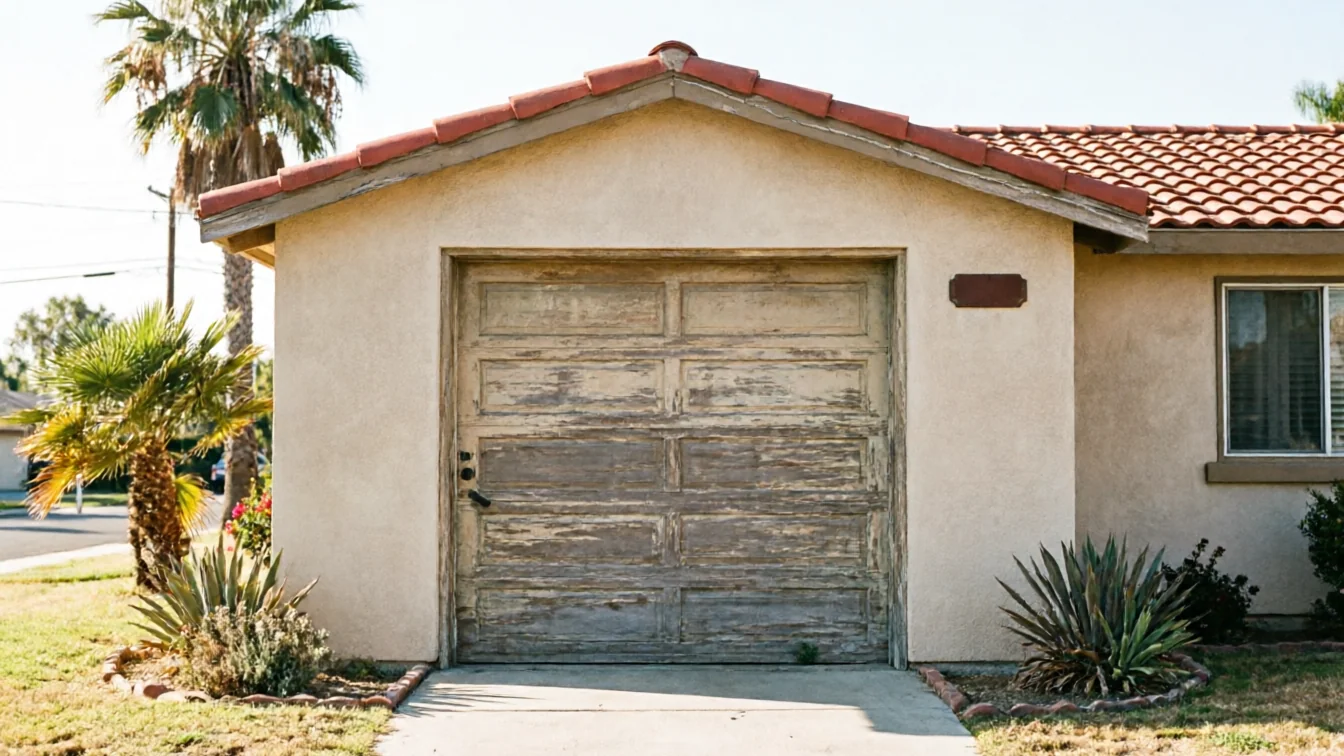
Most of the garage doors we get called out to in Dublin were installed when the house was built, and that house was probably built between 1938 and 2010, with the median landing around 1972. Across the 24 named areas that make up this part of the valley, the bulk of the stock is 1960s and 70s construction. That matters because a door from that window usually came with a different kind of hardware than what's sold today: single torsion springs sized for lighter steel panels, extension spring setups on older single-car doors, and openers that have long since been discontinued.
When a homeowner calls about a door that won't open, the first question we ask ourselves isn't 'is this fixable' - it's 'does this door still have parts behind it.' A 1972-era torsion spring is a known size, and we can source or wind an equivalent. A bent track or a warped panel on a door that age is usually a different conversation, because the panel profile may not exist anymore and patching one section means a mismatch you'll see from the driveway.
So the honest starting point is this: age alone doesn't condemn a door. What condemns a door is whether the specific part that failed is still something a torsion spring shop or a parts house carries, or whether we're trying to rebuild something no one makes.
What Changes With the Season
This area sits in a mild climate band with occasional freeze nights, not the deep freeze-thaw cycling that tears apart hardware in colder regions. That's good news for steel and good news for springs - you're not fighting the metal fatigue that comes from repeated hard freezes. But 'occasional freeze' still means something on the mornings it happens. Torsion springs tighten slightly in cold, and an opener's force settings calibrated for a 60-degree afternoon can struggle on a 38-degree morning, especially on a door that's already a little heavy from age or a slightly bent track.
The bigger seasonal driver here isn't cold, it's the swing between damp winter mornings and dry summer heat. Wood-look composite panels and any door with wood trim pieces expand and contract across that range, and on a door built in the 1960s or 70s that wood trim has been doing this for fifty-plus years. You'll see it as a seam that doesn't quite close flush anymore, or a panel that's started to crown at the center.
None of this is dramatic weather damage. It's slow, cumulative movement, and it's exactly the kind of wear that makes a 50-year-old door feel heavier and louder than it used to, even with no single part actually broken.
When It Stops Being a DIY Job
A torsion spring under tension can put someone in the hospital, and that doesn't change based on how old the door is. If the spring's broken, that's a call, not a weekend project, regardless of what year the house went up.
Where age actually changes the calculation is in panel and track work. A single bent roller track on a door from the 1972 median build year is often a straightforward swap - the track hardware itself isn't proprietary. But if the door's steel has started to rust through at the bottom panel, which we see on original doors from that era that have never been replaced, you're not fixing a panel anymore, you're buying time on a door that's going to need full replacement within a few years anyway.
Here's the limitation we're upfront about: we don't rebuild wood doors from scratch, and if the original door on a 1960s or 70s Dublin house has wood rot through the stile, repair isn't the honest answer - replacement is. We'll tell you that instead of billing you for a patch that won't hold. The dividing line is simple: if the failed part is hardware (springs, cables, rollers, the opener), fix it. If it's structural steel or wood that's failed, that's a door replacement conversation, not a repair one.
How Local Conditions Play In
Dublin sits among a cluster of communities - Camino Tassajara and Norris Canyon five miles out, Blackhawk at six, Castro Valley and Fairview within eight or nine - and the housing age pattern repeats across most of them: 1960s-70s builds dominating, original doors still in place on a meaningful share of houses. That's relevant to how we stock parts and quote jobs, because the torsion spring sizes and opener mounts that fit a Dublin house from that era are usually the same ones that show up in Alamo or San Lorenzo calls too.
Income in this service area runs high, with a median household income around $172,226 across roughly 97,369 owner-occupied homes in the broader area. We mention that only because it shapes the actual decision homeowners make: replacement is financially on the table here in a way it isn't everywhere, so when we tell you a 50-year-old door's track is failing, you're often choosing between a real repair and a real upgrade, not being pushed toward the cheaper option by default.
We don't service every town on that list - our calls concentrate around Dublin itself - but the hardware and build-year patterns hold across the wider area, which is part of why we can speak to this specifically rather than in general terms.
Frequently asked questions
Is it worth fixing a garage door on a house built in the 1960s or 70s?
Usually yes, if the problem is hardware - a spring, cable, roller, or opener. Those parts are standard sizes and still available. It stops being worth it when the steel panel itself has rusted through or the wood trim has rotted, which we do see on original doors from that build era that have never been touched.
Does Dublin's climate cause garage door problems?
Not the dramatic kind. This area is mild with occasional freeze mornings, so you won't see the freeze-thaw damage colder climates get. What you do see is slow wear from the swing between damp winters and dry summers, which shows up as trim seams opening up or panels crowning slightly over decades.
How do I know if my old door's parts are even still available?
Torsion springs are sized by measurement, not by brand, so a correctly measured spring from a 1970s door can usually be matched or wound to spec. Panel profiles and some older opener mounts are a different story - those are the parts most likely to be discontinued, which is when replacement starts making more sense than repair.
Related garage door services in Dublin
More garage door guides
Book garage door service in Dublin
Call now or request a quote - tell us what the door is doing and where you are.