Dublin, CA · Garage Door Service
Garage Door Repair and Service for Dublin, CA Homes
Dublin homes mostly date to the 1960s-70s building boom, which means original hardware is wearing out at the same time across the same streets. Here's why, and what to do.
- Repairs & new doors
- Springs & openers
- Serving 5 nearby communities
Why It Happens Here
Dublin's housing stock runs from 1938 to 2010, but the median build year sits at 1972, and most of the neighborhoods here went up during that 1960s-70s wave. That matters for garage doors because a torsion spring has a rated cycle life, and a door installed in 1970 has been through decades of lift cycles on hardware nobody manufactures the same way anymore. If your house is in one of the older pockets of town, your spring, drum, or cable setup is probably original or a straight swap from the 1980s or 90s, not a modern system.
The climate here is mild with occasional freeze, which doesn't stress rubber seals and lubricant the way a harsher freeze-thaw cycle would, but it does mean grease hardens slowly over years rather than failing suddenly. Owners in Dublin tend to notice stiffness and noise creeping in gradually rather than a dramatic breakdown - which is exactly the pattern you'd expect from 1960s-70s torsion hardware aging out quietly under a stable climate. The door doesn't fail because of weather shock. It fails because the parts are simply old.
How We Fix It
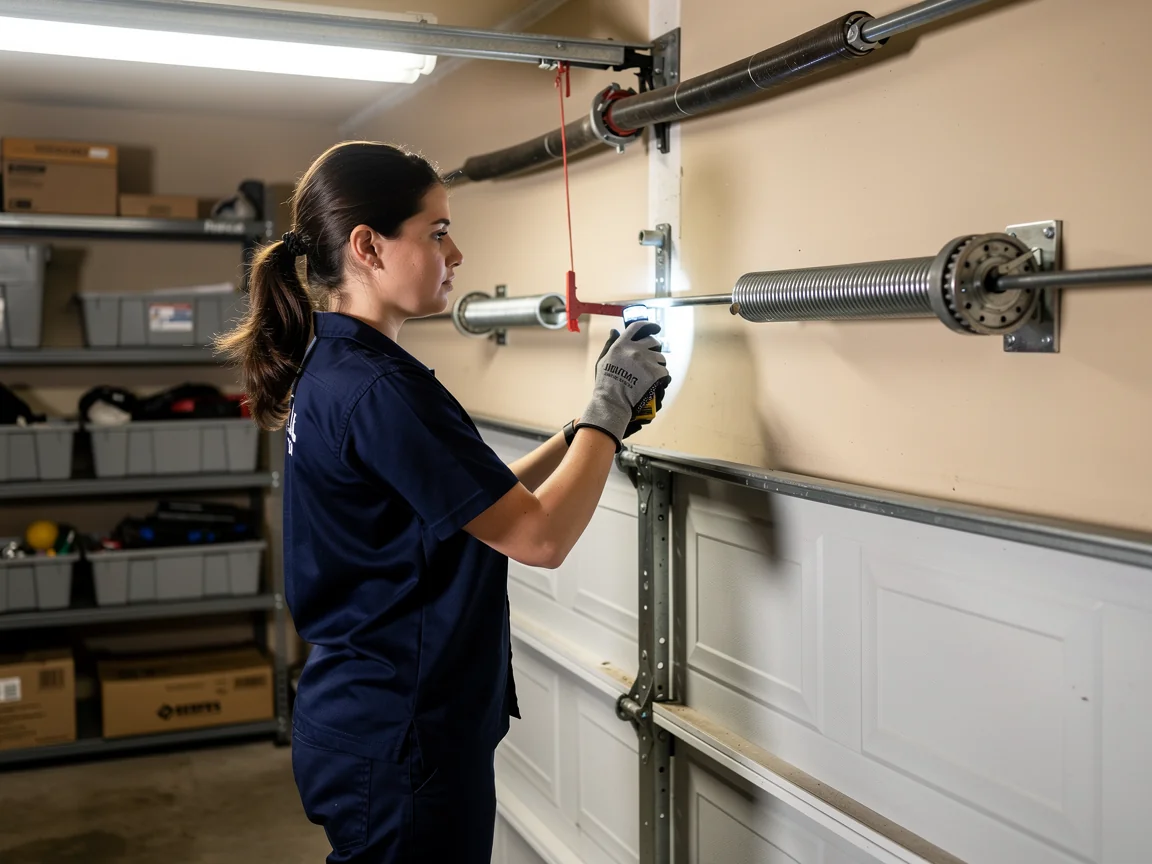
We start by identifying what generation of hardware is actually on the door, because a house built in the 1960s or 70s often has a different spring and track configuration than something built after 2000. Side-mounted torsion springs and older extension-spring setups need different replacement parts than what ships standard today, so matching the shaft size and drum type correctly the first time saves a second trip.
Once we know what we're working with, the fix is usually one of three things: replace the spring and leave the rest of the system alone if the track and rollers are sound, replace rollers and cable if the spring is fine but the door is rough and loud, or recommend a fuller hardware upgrade if we find multiple original 1970s-era parts failing close together. We don't push a full replacement on a door that only needs a spring. If the opener is original to a 1970s install, we'll tell you straight whether it's worth keeping or whether the motor and gear are at the end of their practical life.
The Cost of This Job
We can't quote a firm price here without seeing the door, because the right fix depends on spring size, drum type, and whether the track or opener is also past its working life - all of which varies a lot across Dublin's mix of 1938-to-2010 housing. A straightforward torsion spring swap on an older single-spring setup is a different job, with different parts, than a double-spring system on a wider door.
What we can tell you is what drives the number up or down: how many springs the door uses, whether the drums or cables need replacing alongside the spring, and whether the opener is original equipment that's also due. Houses from the 1960s-70s wave in Dublin often need the spring and the rollers done together, since both wear out on the same timeline. We'll walk the door with you before we quote anything, and we'll tell you if a repair isn't worth it compared to replacing the unit.
The Symptom
The most common call we get from Dublin is a door that's suddenly heavy to lift by hand, or an opener that strains, reverses, or stalls partway up. That's almost always a torsion spring that's lost tension, and on a house from the 1960s-70s building wave, that spring has likely never been replaced. You might also hear a loud bang from the garage - that's the spring letting go, not the opener failing.
A second common pattern is a door that's noisy and slow to respond but still closes - rollers and bearings worn down after decades of use, common on original hardware from that era. Either way, don't keep running the opener against a dead spring. It burns out the motor faster and turns a spring job into a spring-and-opener job.
Frequently asked questions
How do I know if my garage door spring is original to the house?
If your Dublin home was built in the 1960s or 70s and the spring has never been serviced that you know of, it's likely original or an old replacement. Signs include visible rust, a spring that looks thinner on one coil, or a door that's gotten progressively heavier to lift by hand over the past year or two.
Why does my opener strain but the door still moves?
That's usually a spring that's lost most of its tension, forcing the opener motor to do the lifting work the spring used to handle. It's common on original 1960s-70s hardware. Running the opener like this for long wears out the motor and gears faster, so it's worth having the spring checked before the opener fails too.
Can you give me a price over the phone?
Not accurately. Spring size, drum type, and whether rollers or cables also need replacing all affect the job, and those vary even between houses built in the same decade here. We look at the door in person before quoting.
By Neighborhood
Garage Door Service across the Dublin area
We also handle garage door service in these Dublin-area suburbs.
Book garage door service in Dublin
Call now or request a quote - tell us what the door is doing and where you are.