Dublin, CA · Garage Door Service
Garage Door Opener Installation in Dublin, CA
Opener installation for Dublin, CA homes built mostly in the 1960s-70s, where aging chain drives and worn logic boards are the most common reason owners call.
- Repairs & new doors
- Springs & openers
- Serving 5 nearby communities
Why It Happens Here
Most of the garage door openers we get called out to replace in this service area are original to the house or close to it. Housing here runs from 1938 to 2010, with the typical home going up around 1972, and the bulk of the stock across the 24 named areas we cover dates to the 1960s and 1970s. That means a lot of chain-drive units from an era before rolling-code remotes, auto-reverse safety sensors, and battery backup were standard equipment. The motor itself might still turn over, but the logic board, the capacitor, or the drive gear is past its working life, and parts for units that old are getting hard to source at all.
Climate plays a smaller role here than it does in colder regions, since the area sits in a mild band with only occasional freeze risk. That keeps weather-driven opener failure lower than you'd see further inland or at elevation, but it doesn't erase the age problem. A 50-year-old opener wears out on schedule whether the winters are hard or soft. What we see most is the mechanical side giving up first: stripped gears, a motor that hums but won't lift, or a unit that only responds when you hold the wall button.
How We Fix It
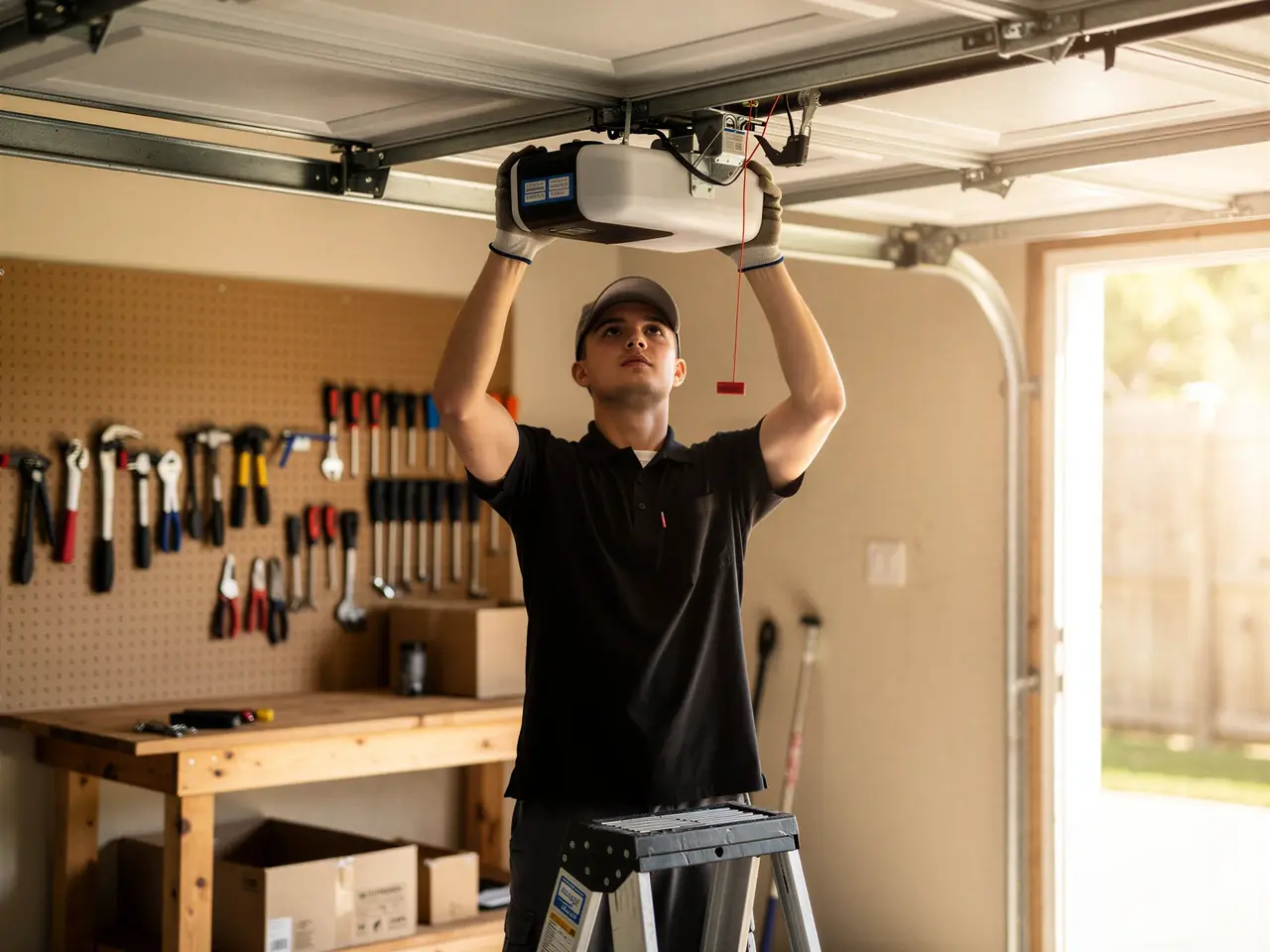
Opener installation starts with the door, not the motor. We check the spring tension, the track alignment, and the panel weight before we pick a unit, because an opener sized for a light door will burn out fast on a heavy one, and that mismatch is behind a lot of early failures we get called back to fix. Once we know what the door needs, we pull the old rail and motor, mount the new header bracket, and run the rail level so the carriage doesn't bind partway through its travel.
We set the travel limits and force settings by hand rather than trusting factory defaults, since every door has a slightly different balance point. Safety sensors get aligned and tested with an actual obstruction, not just a visual check, and we program remotes and any wall console before we call the job done. If the existing wiring or wall button is original to the house, we'll flag it, since older low-voltage wiring sometimes isn't worth reusing. We don't force a customer into a smart-opener upgrade if a basic unit does the job they actually need.
The Cost of This Job
We don't have a flat number to hand out here, because the cost of an opener install depends on what's already on the door: whether the existing rail and bracket can be reused, whether the door itself needs spring or hardware work at the same time, and which drive type you choose. What we can say is that houses built in the 1960s and 1970s - which is most of what's on the ground here - often need more than a motor swap. The header bracket may be undersized for a modern unit, or the track may be the older style that doesn't mate cleanly with a new carriage.
That's the honest limitation: a straight motor-for-motor swap is the cheapest version of this job, and it's not always the version a 50-year-old setup actually qualifies for. We'll tell you up front if your door needs bracket or track work added to the opener swap, rather than quoting the bare-minimum job and adding to it once we're already on the ladder.
The Symptom
The calls usually start the same few ways. The door doesn't move at all when you press the button, but the motor hums - that's a stripped gear or a worn-out capacitor, common once a chain-drive unit passes the couple-decade mark. Or the door moves partway and stops, reversing on its own, which points to the force settings drifting out of range as the motor ages, something that shows up more in older units than new ones.
Sometimes it's the remote: the fob used to work from the driveway and now only works right up against the door, or stopped working entirely. That's often the receiver board failing, not the remote battery, especially on pre-rolling-code systems common in older housing stock. A few owners call because the opener runs but the door doesn't lift square - one side drags - which is usually a cable or spring problem riding along with the opener issue, not the opener itself. We'll tell you which one it is before we quote anything.
Frequently asked questions
Is my current garage door opener too old to repair instead of replace?
If the unit predates rolling-code remotes and auto-reverse safety sensors, parts are often unavailable new, and a repair ends up costing close to what a new unit runs. Given how much of the housing here dates to the 1960s and 70s, this comes up often. We'll check before recommending replacement over repair.
Will a new opener work with my existing garage door track and bracket?
Sometimes, sometimes not. Older homes in this area often have header brackets and rail mounts that weren't built for a modern carriage system. We check the existing hardware on site before quoting, since reusing what's sound keeps the job smaller and cheaper.
Do I need a smart opener with phone control?
Not unless you want one. A standard opener with a wall console and remotes does the same lifting job reliably. We'll install whichever type you choose, but we won't push a smart unit on a house that doesn't need it.
How does the local climate affect opener lifespan here?
This area sits in a mild band with only occasional freeze risk, so weather-driven failure is less common than in colder regions. Age and mechanical wear are the bigger factors - a unit from the 1970s or 80s wears out on its own schedule regardless of winter severity.
Related guides
By Neighborhood
Opener Installation across the Dublin area
We also handle opener installation in these Dublin-area suburbs.
Book garage door service in Dublin
Call now or request a quote - tell us what the door is doing and where you are.