
Dublin, CA · Garage Door Service
When a Dublin Garage Door Spring Breaks in the Cold
Why Dublin's 1960s-70s garage doors snap springs on the rare freeze night, and what the original hardware on these houses means for your repair.
- Repairs & new doors
- Springs & openers
- Serving 5 nearby communities
What Is Going On
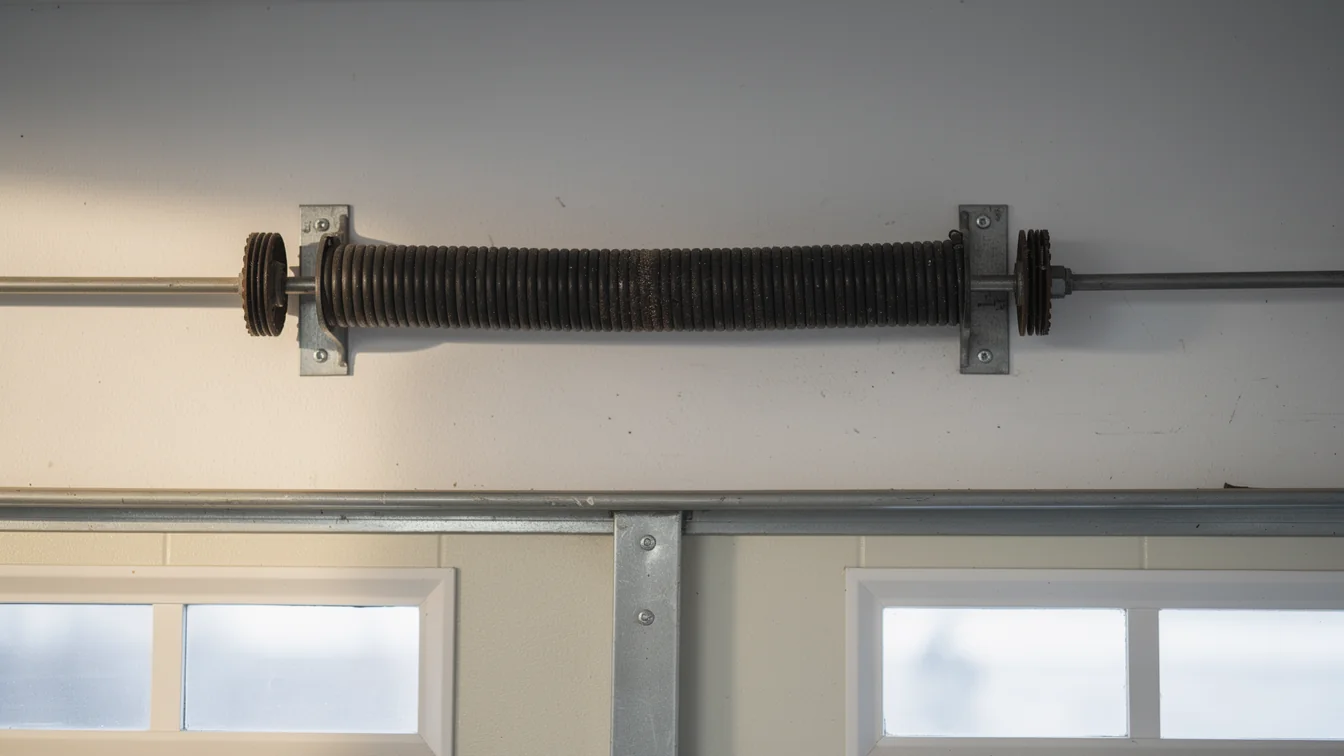
A torsion spring doesn't care about the calendar, but it does care about temperature. Steel contracts when it's cold, and a spring that's already fatigued from years of lifting a heavy door will pick the coldest morning of the year to let go. In Dublin that coldest morning doesn't come often - this is a mild climate band with only occasional freeze nights - but when it hits, the phone rings the same way it would anywhere winter actually settles in.
The twist here is the housing stock. Homes in this service area were built mostly between 1938 and 2010, with the median house going up around 1972, and the surrounding communities carry that same mid-century wave - mostly 1960s and '70s construction across two dozen nearby areas. A spring installed when that house was framed, or a replacement from decades back, has already cycled tens of thousands of times before it ever meets a freeze night. Cold doesn't cause the break on its own. It's the last straw on a spring that's been losing temper for years.
If your door is original to a house from that era, the spring gauge and drum size were matched to hardware nobody stocks on the shelf anymore. That's not a reason to panic - it's a reason to call before the door is stuck shut with the car inside.
What Changes With the Season
Dublin doesn't get the hard freezes that crack pavement, but the someFreeze label on this climate band means a handful of nights a year do dip below freezing, usually in the small hours. That's enough to stiffen the lubricant in an old spring coil and change how much load it's carrying when the opener pulls. A spring rated for a door's weight at 55 degrees is working harder at 32.
Because freeze nights here are occasional rather than routine, most homeowners never think about cold-weather load until the year it actually happens to them. The pattern we see is a door that's been a little stiff or noisy for months, then one cold morning it finally gives. The cold isn't hiding a new problem - it's exposing one that was already there.
The practical takeaway: if your door has been making noise through the fall, don't wait for the one freeze night of the year to find out how bad it is. A spring under tension in cold metal breaks faster and more violently than one that lets go on a warm afternoon, and it's the kind of failure that can bend a track or crack a panel on the way down.
When It Stops Being a DIY Job
A broken torsion spring on a double door is not a bolt-it-back-together repair. The spring is wound under enough tension to do real damage to a hand or a face, and that's true whether the house is from 1962 or last year. We're not going to pretend otherwise just to keep this page short.
Where Dublin's older housing stock changes the calculus is parts. A house from the 1960s or '70s median era may still have its original door track, hinges, or a drum sized for hardware that's been superseded twice over. Swapping a modern spring onto an old drum without checking the match is how you get a door that lifts unevenly or a cable that jumps the track within a month.
If the door is original to a house built before, say, the early 1970s and has never been upgraded, it's worth asking whether a full spring and hardware replacement makes more sense than patching one broken coil. That's a judgment call that depends on the actual door in front of us, not a rule we apply to every call.
How Local Conditions Play In
With median household income in this service area at $172,226 and roughly 97,369 owner-occupied houses out of 168,551 households, most of what we see is homeowners deciding between a spring repair and a full opener or door replacement - not whether they can afford either one. That changes the conversation. We'd rather tell you a 15-year-old opener with a tired spring is worth replacing as a set than sell you a patch twice.
The geography matters less than the housing age does. Whether your street sits closer to Camino Tassajara or out toward Fairview, the deciding factor on a broken spring is almost always when the door and its hardware were installed, not which side of town you're on. The mild climate here means we're not fighting ice and snow loads the way some regions do - our failures are almost always fatigue plus one cold night, not weather damage itself.
One limitation worth saying plainly: if a drum or shaft is a discontinued size from an older door, we may need to order the part rather than carry it on the truck, which can push a same-day job to the next day.
Frequently asked questions
Why did my garage door spring break on the one cold night this year?
Cold steel loses a little flexibility, and a spring that's already fatigued from years of cycling is working harder at 32 degrees than at 55. In Dublin's mild climate, freeze nights are occasional, so most springs that break in the cold were already near the end of their life - the cold just picked the night.
Is my door's hardware old enough to be a problem for parts?
If your house was built around the 1972 median for this area, or earlier, your drum and spring sizing may not match what's commonly stocked today. We check the actual hardware before ordering - some jobs need a part brought in rather than pulled off the truck.
Should I replace the spring or the whole opener?
Depends on the opener's age and how it's been running. If the opener is old enough that the spring failure is really the second sign of wear, replacing both together usually costs less over time than patching the spring now and the opener in a year.
Related garage door services in Dublin
More garage door guides
Book garage door service in Dublin
Call now or request a quote - tell us what the door is doing and where you are.