
Dublin, CA · Garage Door Service
Why Your Garage Door Jumps the Track
Dublin's 1960s-70s tract housing and mild-with-frost climate both play into why doors jump track. Here's what's mechanical, what's seasonal, and when to stop fixing it yourself.
- Repairs & new doors
- Springs & openers
- Serving 5 nearby communities
What Is Going On
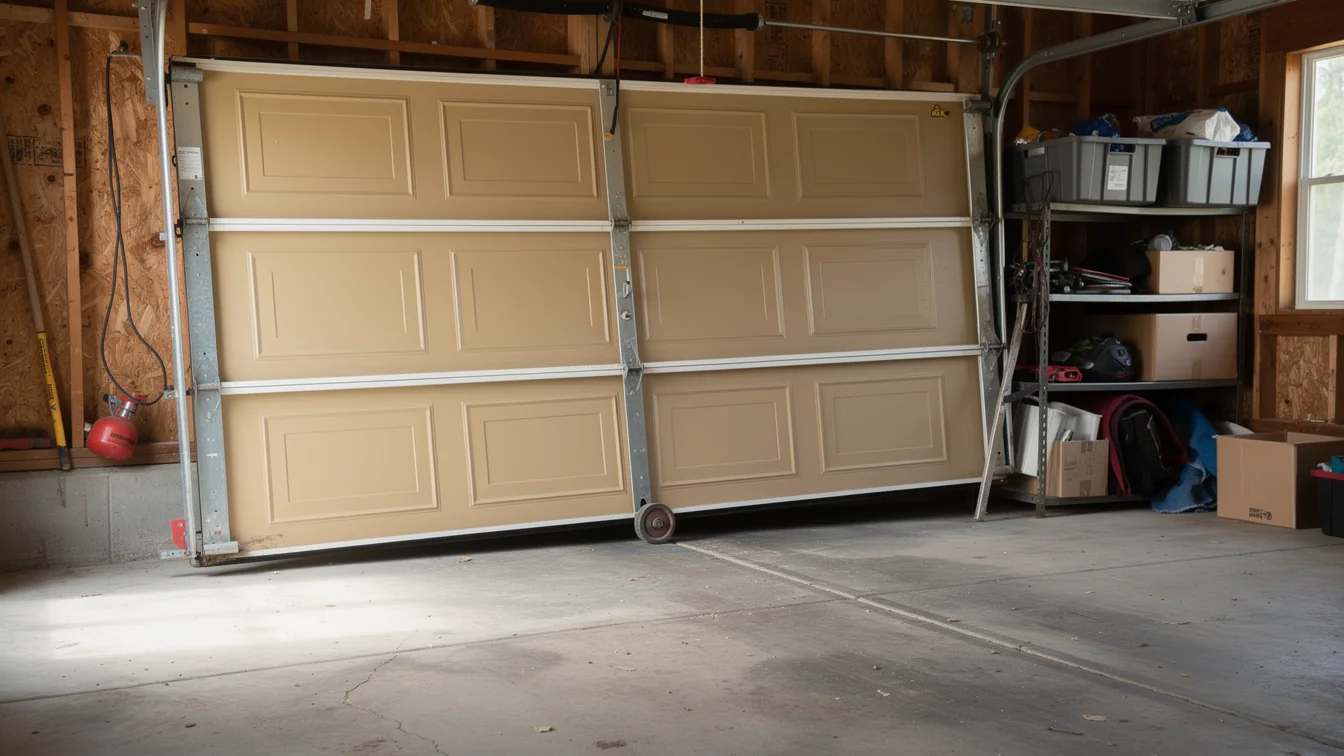
A door goes off track when the rollers stop riding inside the steel channel the way they're supposed to. Usually it's one of three things: a roller has worn down or cracked, a bracket holding the track has loosened and let the rail twist out of alignment, or something hit the door hard enough to bend the track itself.
Housing in this area was built mostly between 1938 and 2010, with the median landing around 1972, and that matters here. A lot of the track hardware still in service was installed to fit rollers and drums that were standard in that era - sized a little differently than what hardware stores stock today. When a roller finally gives out and gets swapped for a modern one, it can ride slightly differently in an old channel, which shows up a few months later as a door that creeps toward one side every time it closes.
The fix is almost never "push the track back and tighten the bolts." If the track is bent, it has to come off and get replaced or straightened on a bench - bending it back in place usually just moves the weak point a few inches down the rail.
What Changes With the Season
This area sits in a mild climate band that still sees occasional freeze mornings rather than a hard winter. That combination is actually harder on hardware than either extreme alone. A true freeze-thaw climate forces homeowners to re-lubricate on a schedule because everyone expects it. Here, where most mornings are mild and only some dip below freezing, grease on rollers and hinges tends to get neglected until a cold stretch stiffens it overnight - and a stiff roller dragging through a track is one of the more common ways a door starts to walk off alignment.
Humidity swings do the rest. Steel track doesn't expand and contract dramatically in this climate, but the lag bolts holding brackets to framing do loosen slowly over years of small seasonal movement, especially in homes built in the 1960s and 70s where the original framing lumber has had five or six decades to settle. A bracket that's a quarter-inch loose doesn't look like a problem. It is one - it's usually the first domino.
When It Stops Being a DIY Job
Tightening a loose bracket or clearing debris out of a track is reasonable to do yourself. Once the track itself is bent, or a cable has jumped its drum, that's a different job - the door is under spring tension and a track that's forced back into shape under load can kick back hard enough to hurt someone.
We'll say plainly: we don't recommend trying to re-align a track that's visibly bowed by eye and a level, because by the time it's visible, the steel has usually taken a permanent set and straightening it is a temporary patch at best. Replacement of that section is the honest answer most of the time, even though it costs more upfront than a quick bend-back.
If the door is dragging, grinding, or has come fully off one roller, that's also past the DIY line. At that point the opener is often still trying to drive a door that isn't moving freely, which stresses the motor and the top panel both. Call before it gets there if you can - a loose bracket is a ten-minute fix, a seized opener fighting a bent track is not.
How Local Conditions Play In
Dublin's housing stock clusters heavily in the 1960s and 70s build era, same as much of the surrounding stock across the 24 named areas in this region. That generation of garage was built with steel tracks on side-mounted torsion hardware, bolted to framing that's now had fifty-plus years to shift slightly with the seasons.
The mild-with-occasional-freeze climate here doesn't crack concrete slabs or warp wood the way harder winters do elsewhere, so the track problems we see are rarely weather damage in the dramatic sense. They're slower - a bracket that's loosened a sixteenth of an inch at a time, a roller that's gone dry because nobody expected a mild climate to need regular lubrication, a door that's been walking a little further off-center every month for two years before anyone notices.
That's actually good news in one sense: if you catch it before the track is visibly bent, most of this is a bracket and roller job, not a full track replacement.
Frequently asked questions
Why does my garage door only jump off track in the morning?
Cold mornings stiffen grease on rollers and hinges, even in a mild climate like this one with only occasional freezes. A stiff roller drags instead of rolling, and a dragging roller is one of the most common ways a door starts walking off the track. It usually loosens up once the door warms with use.
Is a bent track always a full replacement?
Not always, but once a bend is visible to the eye or shows on a level, the steel has usually taken a permanent set. Straightening it in place is a short-term patch. We'll tell you honestly if a section replacement makes more sense than a bend-back - it usually does.
My house is from the 1970s - is my track hardware outdated?
A lot of homes from that era used track and roller sizing that's slightly different from what's sold today. It's not unsafe, but when a single roller gets swapped for a modern part without checking fit, it can ride unevenly in the old channel and cause drift over time.
Can I tighten the track brackets myself?
Yes, if the track isn't bent. Loose lag bolts on brackets are a common, low-risk fix. Just don't attempt to force a bowed track back into line under spring tension - that's where it stops being a simple tool job.
Related garage door services in Dublin
More garage door guides
Book garage door service in Dublin
Call now or request a quote - tell us what the door is doing and where you are.